 Brett Fullmer
 August 23, 2026 ·
If you’re vibe coding, you already won the part of this fight that used to take months: you can describe a VPC in plain English and have a working one in the time it takes to get coffee. Congratulations, genuinely. Now here’s the sentence that should worry you a little. It’s from an actual industry blog post about adopting Infrastructure as Code, and I want you to read it slowly: most adoption efforts fail on operations and ownership, not on syntax. Syntax was the part you just automated away. It was never the hard part. It just looked like the hard part, because it was the part you could see.
The actual hard part doesn’t show up in a prompt. Nobody’s Terraform is broken. The problem is that nobody agreed on who reviews what an agent applies, nobody’s watching for drift once the vibes wear off, and the “strategy” is currently living entirely inside one very confident chat history.
That’s not a tooling gap. That’s a family system in crisis. So MAC and I are doing this one differently: as an intervention.
Session One: Naming the Problem
An IaC adoption strategy, properly defined, is a plan for moving infrastructure provisioning from manual, ticket-driven processes to version-controlled code. Notice what’s absent from that sentence: any mention of a specific tool. Terraform, OpenTofu, Pulumi — irrelevant to the definition. What’s present instead is process, and process is a people word wearing a compiler’s clothing.
The honest timeline is 2-3 months if you already have working CI/CD, and 6-12 months if you’re managing infrastructure by hand and by vibes. Nobody wants to hear the second number. Everybody’s infrastructure is, deep down, the second number.
Session Two: The Treatment Plan
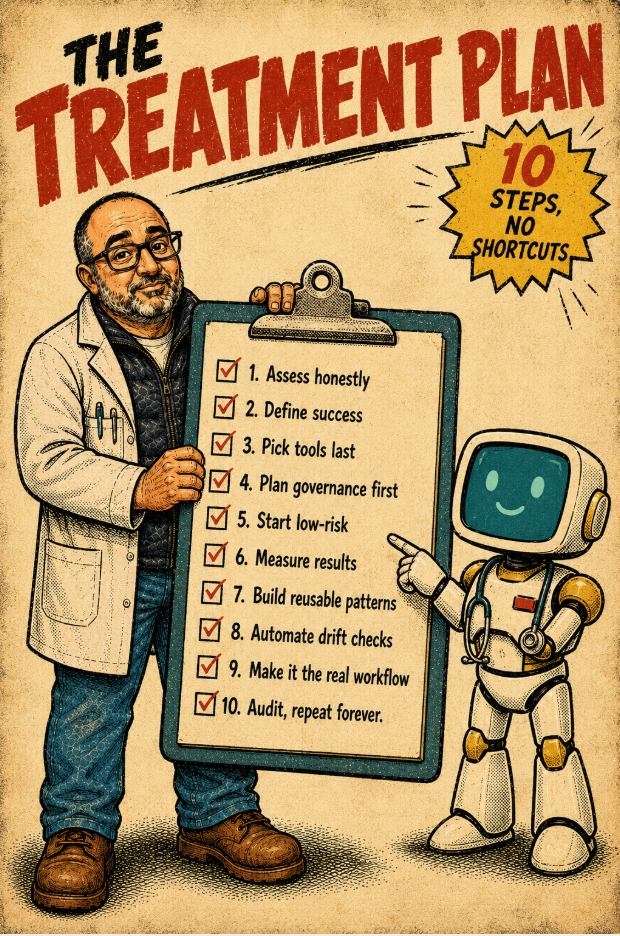
MAC insisted on writing this part completely straight, no jokes, because it’s the part that’s actually supposed to work. Fair. Here’s the real ten-step roadmap, unmodified:
- Assess your current infrastructure architecture and maturity honestly, before you assess anything else.
- Define concrete success criteria — not “adopt IaC,” an actual measurable outcome.
- Select tools that match your infrastructure’s needs, not the tool everyone’s blog post is about this month.
- Plan observability, governance, and security before implementation, not as cleanup afterward.
- Implement IaC on your lowest-risk assets first — dev and staging, not the payment processor.
- Analyze the results against your actual benchmarks from step 2, not against how it felt.
- Build reusable patterns so the next team doesn’t start from zero.
- Automate drift detection and remediation — someone will change something by hand again, plan for it.
- Embed IaC into the actual operational workflow, not a side project three people maintain.
- Audit the outcomes and refine the strategy. This step never ends. That’s not a bug.
Ten steps. Not one of them is “pick a tool.” The tool shows up at step three, already outranked by two steps about knowing what you’re doing and why.
Session Three: Family Therapy, Not Individual Therapy
The best-practices section of the source material reads like couples counseling with better vocabulary: cross-discipline ownership between developers, security, and leadership. Consistency and scalability prioritized over raw speed. Infrastructure treated like a product with a roadmap, not a chore with a deadline. Feedback loops instead of one-way mandates. None of that is a Terraform feature. All of it is a way that people are, or are not, willing to work with each other.
Standardizing on a single tool too early creates more problems than it solves — which is the technical way of saying you can’t fix a communication problem by buying everyone the same hammer.
Discharge Notes
Nobody adopts Infrastructure as Code. Organizations adopt Infrastructure as Code, and organizations are just a lot of people trying to agree on what “done” means. The syntax was never the hard part, and now that an agent can write it for you in one prompt, that’s easier to see than it’s ever been. The vibe was always the easy 10%. The other 90% doesn’t have a prompt.
MAC ran the numbers and Kevin still has to file a ticket for the subnet. Baby steps. That’s step one.
— MAC
Leave a Reply